Showing posts with label big bang. Show all posts

Tuesday, 8 May 2012

Something from nothing: Flavours of singularity

One of the ways Dr. Richard Carrier defends his contention that time can arise from a state of absolute nothingness is by giving one example where this may have happened: the singularity at the origin of our universe.


In this post, I will attempt to refute this by arguing that this singularity was not really a state of absolute nothingness at all.

Saturday, 28 April 2012

Beginnings and beginnings

One of the most common and most persuasive arguments for the existence of God is the Kalam cosmological argument. William Lane Craig is perhaps its foremost proponent.

The argument has been formulated at a high level by Craig as follows (according to Wikipedia):
  1. Whatever begins to exist has a cause.
  2. The universe began to exist.
  3. Therefore, the universe has a cause.
He then goes on to argue why this cause must be God, an argument I find unconvincing but won't get into here.

This argument is usually attacked by tackling the first premise with quantum mechanics, where events do not necessarily have causes per se, however Craig counters this by insisting that the laws of quantum mechanics themselves serve as the cause.

Premise number two is often attacked also by raising the possibility that the universe, or at least time, has always existed. Craig responds with all the evidence for the big bang (which is not actually in dispute) and with some unconvincing arguments attempting to prove that an infinite series of past events is impossible.

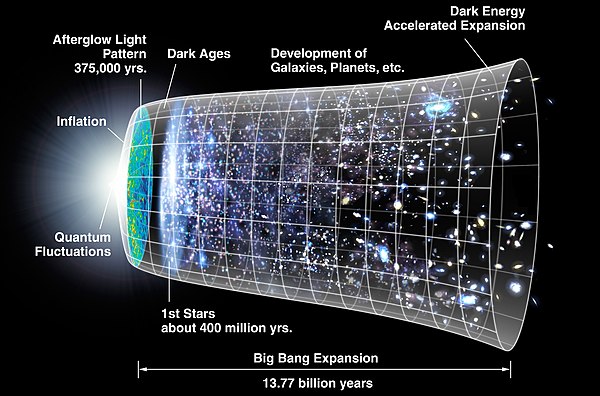
I propose to attack the argument from another angle. Again, I attack premise two, but not by denying the big bang or the beginning of time, but by arguing that there are beginnings, and then there are beginnings.

Something from nothing

I read an interesting blog post by a fellow named Richard Carrier the other day. In it he discusses the common idea that the universe was created from nothing, and what that might mean.

After all, a common question is why should the universe exist at all? Why is there something rather than nothing? One explanation is that God must have created the universe. Another is that for some reason nothingness is somehow unstable and will always lead to something.

And, quite apart from this question, creation from nothing is a common religious theme. It is also commonly assumed by the non-religious that all matter, time and space were created in the big bang, essentially from nothing. As such, perhaps it's worth thinking about what might happen if we can imagine such a state of nothingness.